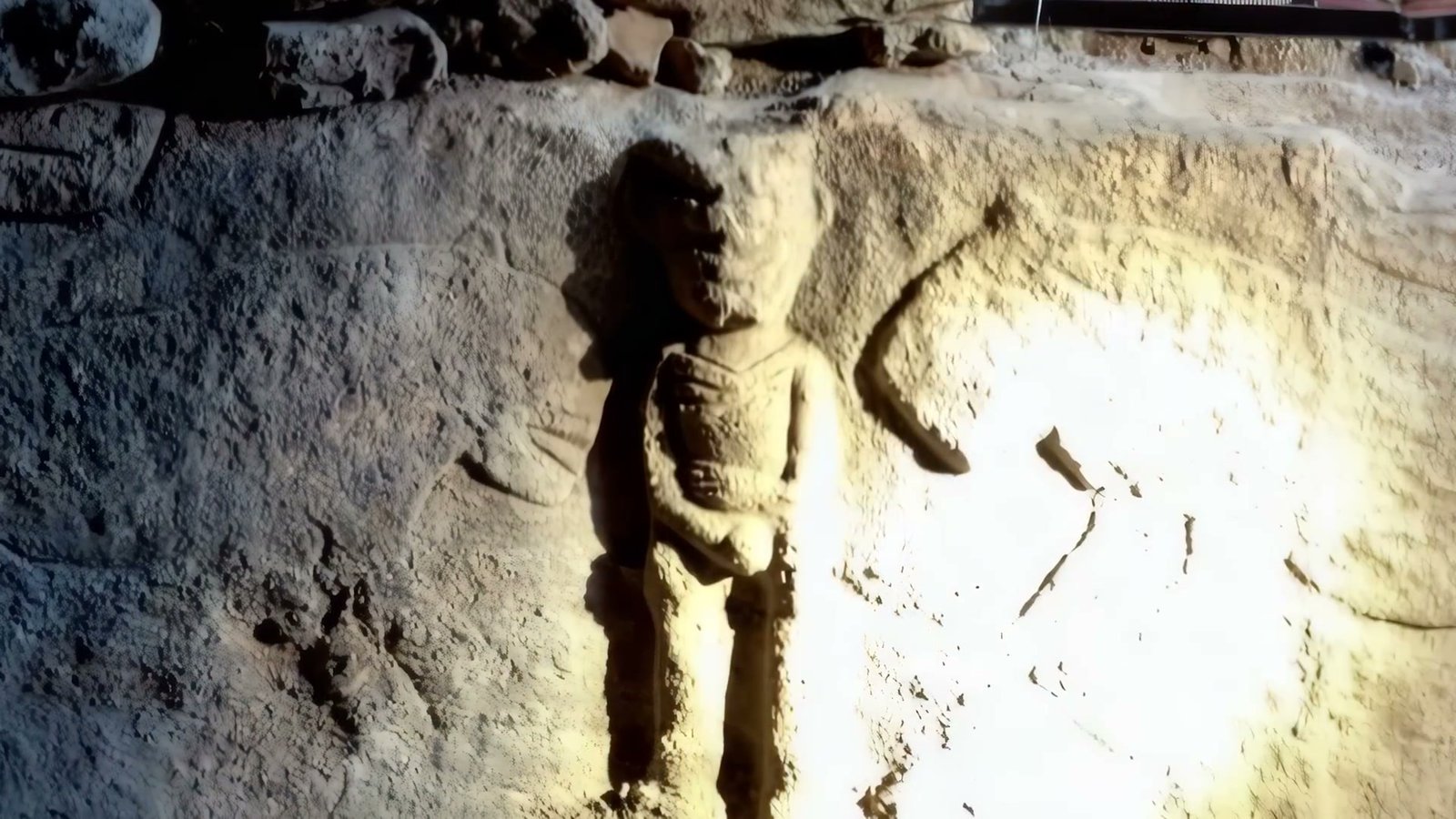
Look closely at the human figures of the Taş Tepeler world and a detail keeps returning: a V-shaped collar or necklace carved around the neck — what you might call a triangle necklace. It appears on the most famous of them all, and it echoes across the region on pillars and sculptures, binding these sites into one visual language.
Urfa Man wears it first
Urfa Man — the Balıklıgöl statue from Şanlıurfa, dated to around 9000 BC — is the oldest known life-size sculpture of a human being. Carved into the stone around his neck are the V-shaped lines usually read as a necklace or collar. He is a contemporary of Göbekli Tepe, and fragments of similar figures, especially heads, come from that site too.
The same triangle necklace, the bulls, the leopards — the same symbols repeating for thousands of years. This is a shared language of myth.
— field commentary on the shared iconography across the Taş Tepeler sites.
The motif travels
The collar is not unique to one statue. Human-form T-pillars across the region carry ornaments — belts, arms, and neck markings — as though they, too, are dressed. Alongside the recurring animals (leopards, bulls, vultures) and the phallic imagery of Karahan Tepe, the necklace is part of a repertoire that stayed remarkably stable across the sites and the centuries.
Why a shared symbol matters
Göbekli Tepe's oldest layers reach back roughly 12,000 years; the youngest phases of these sites are around 10,000. That is nearly two thousand years in which the same handful of signs — the collar, the bull, the leopard, the human form — keep reappearing. Symbols that persist that long are not decoration; they are a held identity, passed down and understood across generations and across hills. Sayburç, with its carved human figures, belongs to that continuity.