Sayburç sits about an hour from Göbekli Tepe, in the cluster of Neolithic sites across Şanlıurfa that archaeologists call Taş Tepeler — "the Stone Hills" — or the wider Göbeklitepe culture. They are not the same site, and Sayburç is not a copy of Göbekli. But they share a symbolic language that ran across this landscape for well over a thousand years.
What they share
- T-shaped pillars. The signature abstract-human pillars of Göbekli Tepe appear at Sayburç too — in communal buildings and inside ordinary houses.
- A shared bestiary. Leopards, bulls, and other animals recur at both sites, part of one regional repertoire. The leopard in particular is a repeated predator motif.
- Communal buildings. Both sites separate special gathering spaces from everyday ones, built to bring people together.
- A concern with the dead. Skulls and human remains are treated with evident care across the region, Sayburç included.
What Sayburç adds
Göbekli Tepe overflows with imagery — but largely as individual figures and symbols. Sayburç's breakthrough is narrative: on its carved bench, figures act on one another in a single scene. If Göbekli gives us the vocabulary, Sayburç is where we first catch these people composing a sentence. And because that scene sits inside a lived-in village, Sayburç also shows the symbolic world woven directly into daily life.
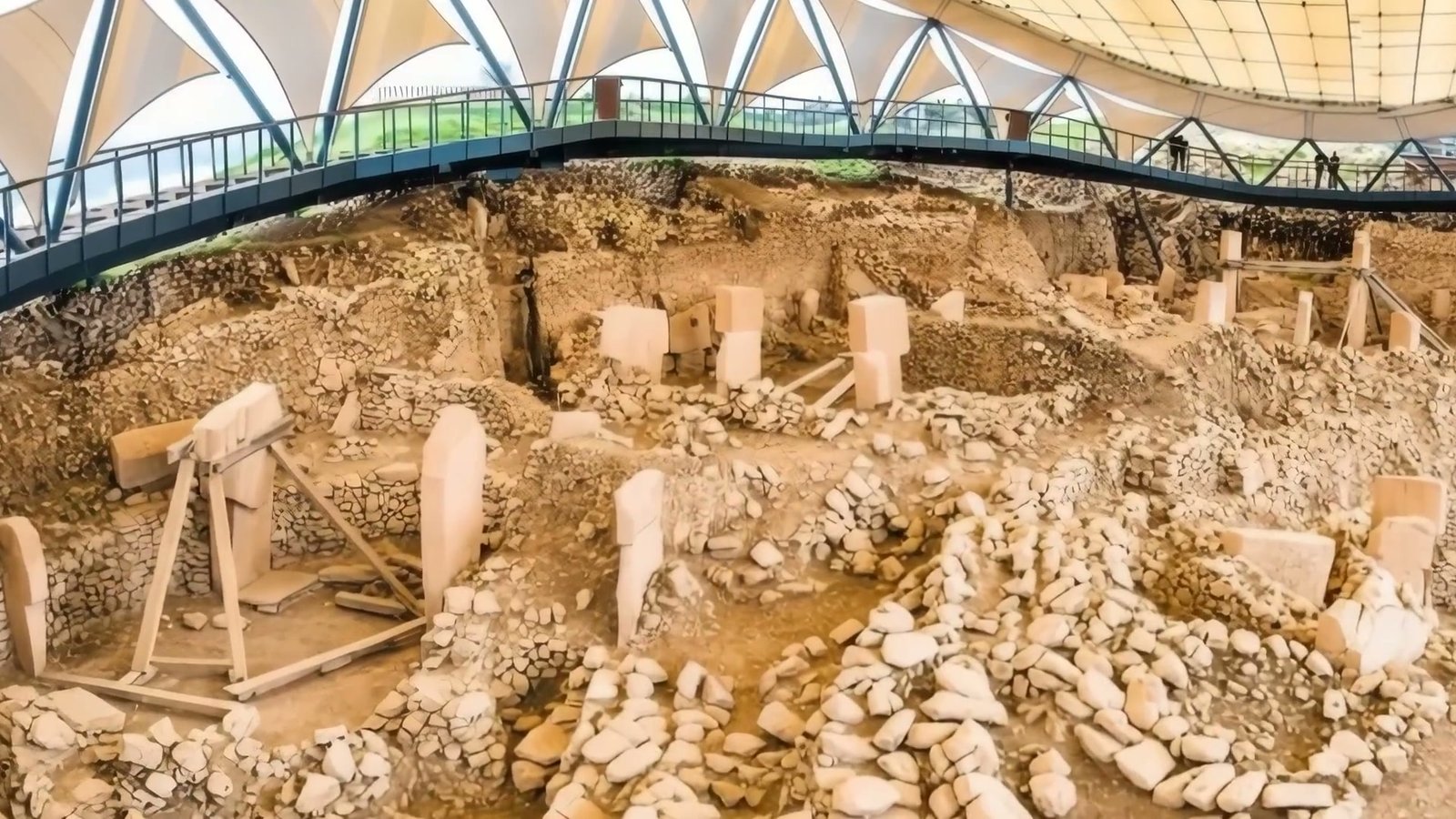
Göbekli Tepe shows us what they drew; Sayburç shows us that they were telling stories with it.
Feasting, gathering — and maybe beer
These sites were places people came together. At Göbekli Tepe, huge quantities of animal bone point to large feasts, and chemical traces in giant limestone basins suggest the fermentation of grain — some of the earliest evidence for brewing anywhere, from before farming was established. Sayburç has its own large stone basins and food-processing gear; whether they were used the same way is a question for ongoing research, but they belong to the same culture of communal gathering.
Sayburç vs Göbekli Tepe, at a glance
| Sayburç | Göbekli Tepe | |
|---|---|---|
| Best known for | The oldest narrative scene | Monumental T-pillar enclosures |
| Character | A village — homes + communal halls | A monumental gathering place |
| Imagery | A composed, readable scene | Individual carved figures & symbols |
| Visiting | Active dig, museum planned | Visitor centre & walkways |
See them together
Because they belong to one landscape, they are best understood together. A guided route links the Şanlıurfa Museum, Göbekli Tepe, Karahan Tepe and Sayburç so the pillars, the carvings and the villages read as one connected world.
Sources
- Özdoğan, E. 2022. "The Sayburç reliefs: a narrative scene from the Neolithic." Antiquity 96(390). Cambridge Core
- Archaeology.org, "Neolithic Structures Found at Site Near Göbeklitepe" (2025). link
- Dietrich et al., "The role of cult and feasting in the emergence of Neolithic communities… Göbekli Tepe." Antiquity. link