Sayburç and Karahan Tepe both belong to Taş Tepeler, share the T-pillar tradition, and sit within an hour of each other near Şanlıurfa. Yet they emphasize different things. Sayburç gives us a readable narrative wall inside a village; Karahan gives us a rock-cut, body-centred world of carved heads and chambers. They're best understood together, not flattened into one.
At a glance
| Sayburç | Karahan Tepe | |
|---|---|---|
| Best known for | The oldest narrative scene | Carved human head & pillar chambers |
| Character | A village — homes + communal halls | Rock-cut special buildings |
| Signature imagery | A composed scene: humans, leopards, bull | Human heads, phallic pillars, the body |
| Domestic evidence | Strong — hearths, houses, storage | Present, but the special buildings dominate |
| Burials | Within the settlement | Human-head imagery & remains |
| Visiting | Active dig, museum planned | Open with visitor access |
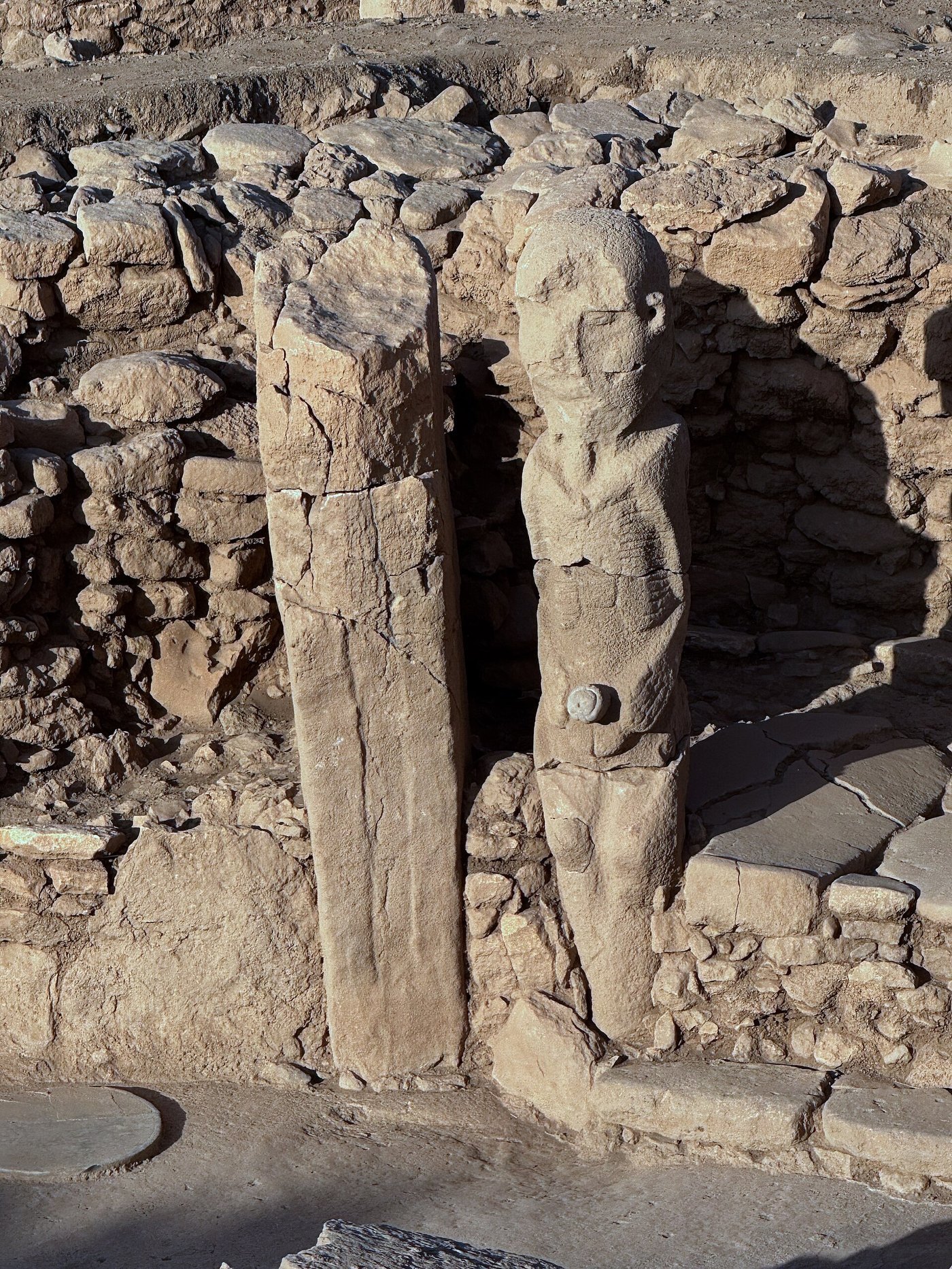
The relief vs the heads
If you remember one contrast, make it this: Sayburç's genius is narrative — figures arranged into a scene you can read. Karahan's is the body — a human head carved from the bedrock, pillars shaped like human forms, an architecture that feels alive. Both are Neolithic; neither reduces to the other.
Why compare at all?
Because the region was a network, not a set of isolated monuments. Reading Sayburç against Karahan shows how a shared symbolic language could be expressed in very different registers — a wall that tells a story here, a room that becomes a body there. That variety is the discovery.
See both on one route
They're close enough to visit in a single trip. A guided Taş Tepeler route pairs them with Göbekli Tepe and the Şanlıurfa Museum so the contrast lands in person.